

DENPASAR, BALI — WartaGlobal.Id
Bali has long been recognized as one of the world’s leading tourism destinations. However, beyond its tourism-driven economy lies another opportunity with the potential to reshape the island’s economic future: the blue economy and maritime industry.
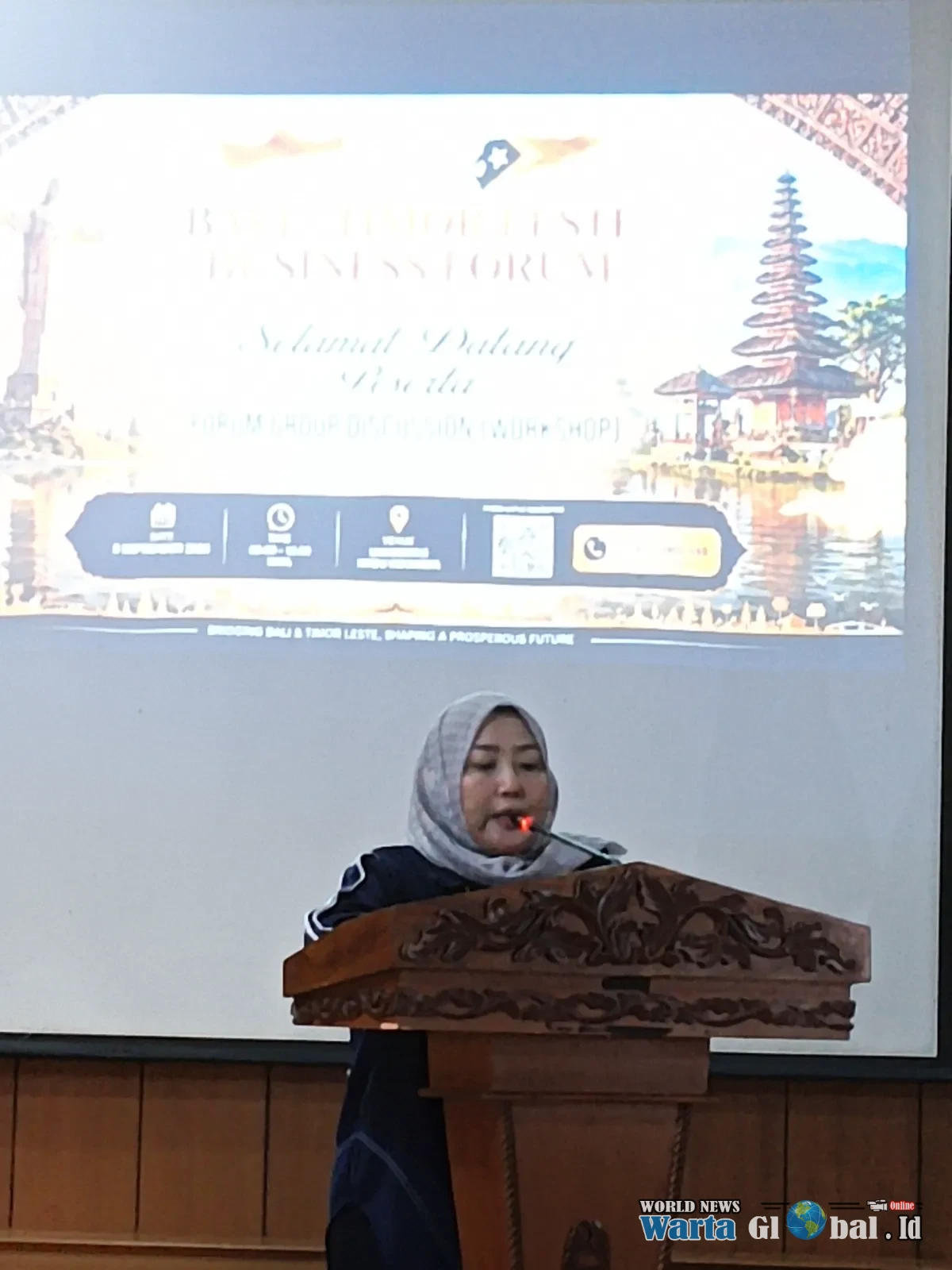
This perspective has been advanced by Febri Hantari, S.H., Secretary General of the Association of Ocean Shipyards of Indonesia (AGSI), ahead of the Bali–Timor-Leste Business Forum.
According to Febri, Bali’s strategic geographic position should be viewed through a broader lens than tourism alone. The island has the potential to develop a stronger maritime ecosystem encompassing shipbuilding, ship repair, maritime services, technology, logistics, human-resource development and investment.
Shipyards Are More Than Places Where Ships Are Built
A modern shipyard is not merely a facility for constructing and repairing vessels.
It represents an extensive industrial ecosystem involving skilled labor, engineering, technology, component manufacturing, logistics, education, maintenance services and supporting businesses.
A stronger shipbuilding sector could therefore generate a broader economic multiplier effect while strengthening Indonesia’s maritime industrial capacity.
“Shipyards are not merely places where ships are built and repaired. They are part of an ecosystem involving workers, technology, component industries, logistics, education, maritime services and communities,” Febri said.
Bali–Timor-Leste: Beyond Tourism and Trade
Febri believes the Bali–Timor-Leste Business Forum presents an opportunity to expand bilateral economic discussions beyond conventional tourism and trade.
The maritime sector offers a broader range of potential cooperation, including shipbuilding, ship maintenance, maritime connectivity, environmentally friendly vessel technology, human-resource development, supporting industries and investment.
The challenge, however, is to ensure that the forum produces more than ceremonial commitments.
Its success will ultimately depend on whether discussions lead to business partnerships, investment projects, technology transfers and measurable maritime cooperation.
Composite Technology and the Future of Shipbuilding
Febri also contributes a technological perspective through his involvement as a legal consultant for PT Dirman Fiberglass and PT Galangan Perkasa Pratama.
The companies have developed vessels operating in Bali waters using a combination of fiberglass composite and carbon-fiber injection technology.
According to technical projections presented by Febri, the technology could potentially reduce vessel weight by approximately 30–40 percent.
Lower vessel weight can reduce draft and water resistance, potentially improving operational efficiency.
Fuel savings are projected at approximately 20–30 percent, while the same engine power could potentially support higher cruising speeds.
The system is also designed to optimize the fiber-to-resin ratio and reduce air voids. Carbon fiber can increase structural stiffness in critical areas such as the keel, hull bottom and stringers.
Composite materials also offer corrosion resistance, potentially reducing long-term maintenance requirements.
However, these projections should ultimately be validated through technical testing under actual operating conditions, as performance depends on vessel design, engine configuration, operating environment and load.
The Real Battle Is About Value Creation
Bali already has a maritime market.
The more important question is:
How much of the economic value generated by that maritime activity actually remains in Bali?
If vessels are built elsewhere, components are imported from outside the region and specialized services are sourced externally, Bali may remain primarily an operating market rather than an industrial center.
Developing a competitive shipyard ecosystem could change that equation.
It could create opportunities for local workers, component manufacturers, engineering firms, maintenance companies, vocational institutions and logistics providers.
That is where the blue economy becomes more than a slogan.
The Blue Economy Must Produce Real Projects
For Febri, the blue economy should not remain an attractive phrase repeated at conferences.
Economic activity at sea must generate value while preserving the ocean as a source of life for future generations.
“The blue economy is not simply about how the ocean generates economic value, but about ensuring that economic activity protects the ocean as a source of life for future generations,” he said.
That principle places sustainability alongside competitiveness.
The future maritime industry must address not only vessel speed and cost, but also energy efficiency, environmental protection, material performance, safety and long-term sustainability.
The Business Forum Must Not Become a Photo Opportunity
The success of the Bali–Timor-Leste Business Forum should not be measured solely by the number of officials, business leaders or delegates in attendance.
The more important questions are:
What happens after the forum ends?
Will business-matching initiatives follow?
Will investment commitments emerge?
Will technology partnerships be established?
Will maritime connectivity improve?
Will shipbuilding cooperation become a reality?
Will local human resources gain new opportunities?
If the answer is no, the forum risks becoming another ceremonial event that fades once the cameras are turned off.
However, if the forum produces concrete projects, it could become a meaningful platform for expanding economic cooperation between Bali and Timor-Leste.
Bali Has the Ocean. Now It Needs an Industrial Strategy.
Febri and AGSI have expressed their openness to cooperation with government, business, academia, communities and other stakeholders in exploring these opportunities.
The ambition is clear:
Bali should not be known solely as a global tourism destination.
It should also become a modern, competitive and sustainable maritime industry hub.
Bali already has the sea.
It has the market.
It has maritime activity.
What remains is the political, industrial and business commitment to transform those advantages into high-value economic activity.
The question is no longer whether Bali can participate in the blue economy.
The real question is:
Is Bali ready to become a maritime player—or will it remain merely the place where other people’s ships operate?
The sea is in Bali. The activity is in Bali. The value must remain in Bali.
Views Post


