Beyond the Newsroom: WartaGlobal Journalists Strengthen Legal, Communication and Technology Intelligence at Bali Dwipa University
By
Admin Redaksi
-
Friday, September 25, 2026
Picture Spesial
DENPASAR Bali, WartaGlobal.Id — Journalism is no longer defined simply by the ability to write and publish a story.
In an era of digital disruption, artificial intelligence, algorithm-driven information, and rapidly evolving public opinion, journalists are increasingly required to understand law, communication, data, research, technology, and information verification.
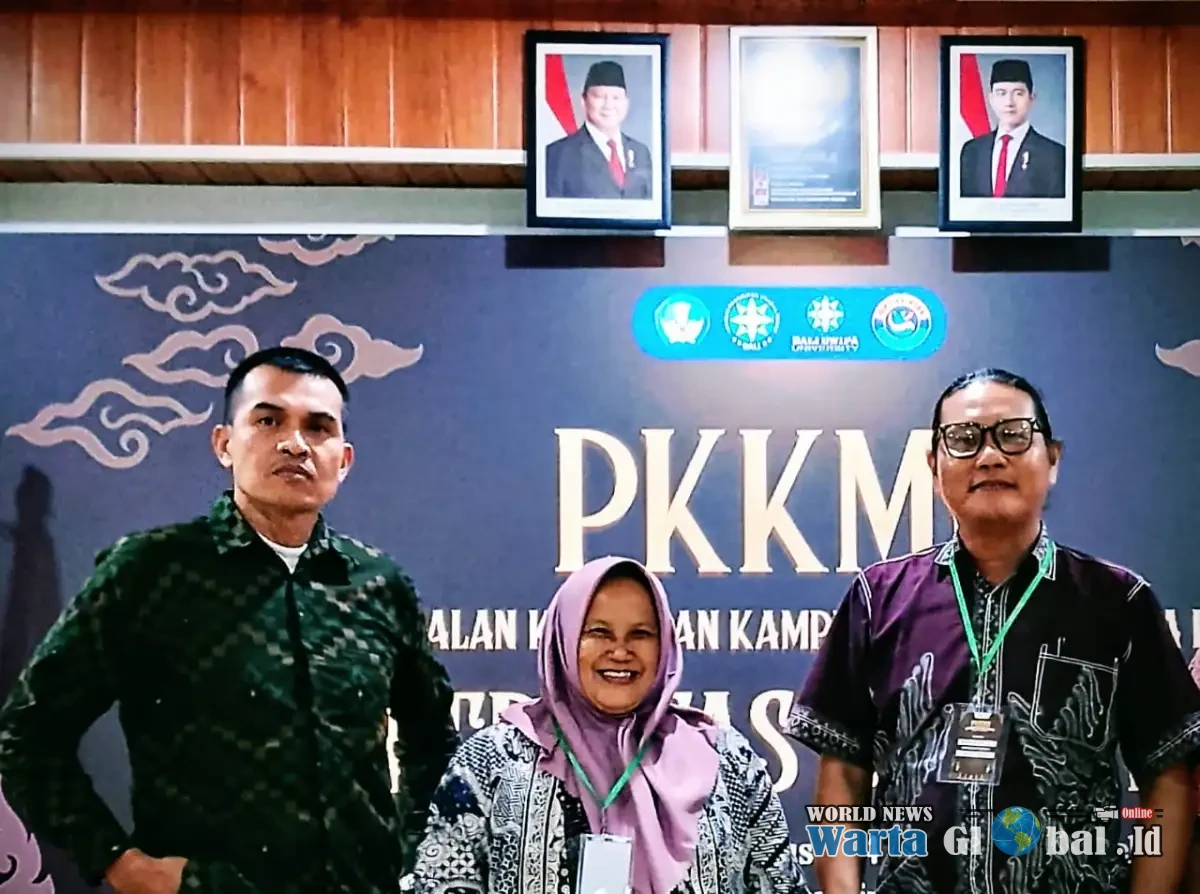
That challenge has encouraged journalists from WartaGlobal to strengthen their academic capacity by participating in the New Student Campus Life Introduction Program (PKKMB) at Bali Dwipa University in Bali.
The journalists are pursuing undergraduate studies in Public Relations and Law—two disciplines that provide complementary perspectives for modern journalism.
From Reporting Facts to Understanding Systems
A journalist does not work only with events.
Behind every major story there are often regulations, institutions, policies, financial data, public communication strategies, and competing interests that require deeper examination.
This is where academic knowledge becomes relevant.
The study of Law provides journalists with a framework for examining legal documents, institutional authority, criminal and civil law, constitutional issues, administrative processes, and the relationship between law and society.
Meanwhile, Public Relations provides knowledge about strategic communication, media, public information, critical analysis, and communication management.
The combination creates an important journalistic foundation:
Facts must be verified.
Documents must be examined.
Statements must be contextualized.
Data must be tested.
Allegations must not automatically be presented as established facts.
Journalism in the Age of Information Overload
The biggest challenge facing journalists today is not a shortage of information.
It is the opposite.
There is too much information.
Social media can accelerate an unverified claim before a journalist has had the opportunity to establish its authenticity. Artificial intelligence can generate convincing text and images, while algorithms can amplify information according to engagement rather than accuracy.
This creates a fundamental question for journalism:
Can information that spreads quickly also be trusted?
The answer cannot be determined by popularity, virality, or the number of views.
It requires verification.
For that reason, journalists need stronger research capabilities, digital literacy, legal awareness, and analytical discipline.
Data-Driven Journalism
For WartaGlobal, strengthening academic competence is also connected to developing a more data-driven journalistic culture.
A serious investigation should be able to move beyond statements and assumptions.
It can examine:
official documents;
government regulations;
budget and financial data;
court documents;
institutional records;
statistical information;
credible sources;
chronology of events;
statements from relevant parties; and
independent verification.
The objective is not merely to produce a longer story.
The objective is to produce a story in which every significant claim can be tested against evidence.
Where Law Meets Journalism
Legal literacy is particularly important when journalists investigate allegations involving public officials, corporations, government institutions, law enforcement, land disputes, public funds, or other matters of public interest.
Understanding the law helps journalists distinguish between an allegation, investigation, legal finding, indictment, conviction, and final judicial decision.
That distinction matters.
A journalist's responsibility is not to act as a prosecutor or judge.
The journalist's responsibility is to investigate, verify, provide context, seek responses from relevant parties, and present information accurately to the public.
Communication Intelligence Matters
Public Relations adds another dimension.
Modern journalism operates within an environment where institutions, governments, corporations, communities, and individuals all have communication strategies.
Understanding communication enables journalists to examine not only what is being said, but also the context in which information is communicated and how public narratives develop.
This does not mean accepting or rejecting a particular narrative.
It means understanding how communication works—and testing public claims against available evidence.
Technology Is a Tool, Not the Final Authority
Artificial intelligence and digital technology can significantly improve journalistic workflows.
They can assist with document processing, transcription, information organization, data analysis, translation, and research.
But technology also creates new risks.
AI-generated content can contain errors. Search results can lack context. Digital images can be manipulated. Automated summaries can omit critical information.
Therefore, technology should support journalism—not replace journalistic judgment.
The final verification must remain human.
From Campus to the Newsroom
The participation of WartaGlobal journalists in PKKMB represents more than a transition into university life.
It marks an effort to connect professional experience with academic knowledge.
The newsroom provides exposure to real-world events.
The university provides theory, methodology, critical thinking, and structured knowledge.
When those two environments meet, journalism can become more systematic:
Research → Data → Verification → Legal Analysis → Confirmation → Context → Publication.
This approach is particularly relevant to investigative journalism, where a single document or statement may require multiple layers of verification before it becomes publishable information.
Building the Journalist of Tomorrow
The future journalist will not simply ask:
“What happened?”
The journalist must also ask:
“What is the evidence?”
“What does the data show?”
“What is the legal basis?”
“Who is affected?”
“Who has been given the opportunity to respond?”
“What remains unverified?”
Those questions form the foundation of responsible journalism.
For WartaGlobal, academic development in Law and Public Relations is therefore part of a broader commitment to strengthening journalistic capacity in the digital era.
Because the future of journalism will not be determined solely by who publishes first.
It will increasingly depend on who verifies better, understands deeper, analyzes more carefully, and remains accountable to the public.
WartaGlobal — I Think and I Speak. Indonesian Journalist.