

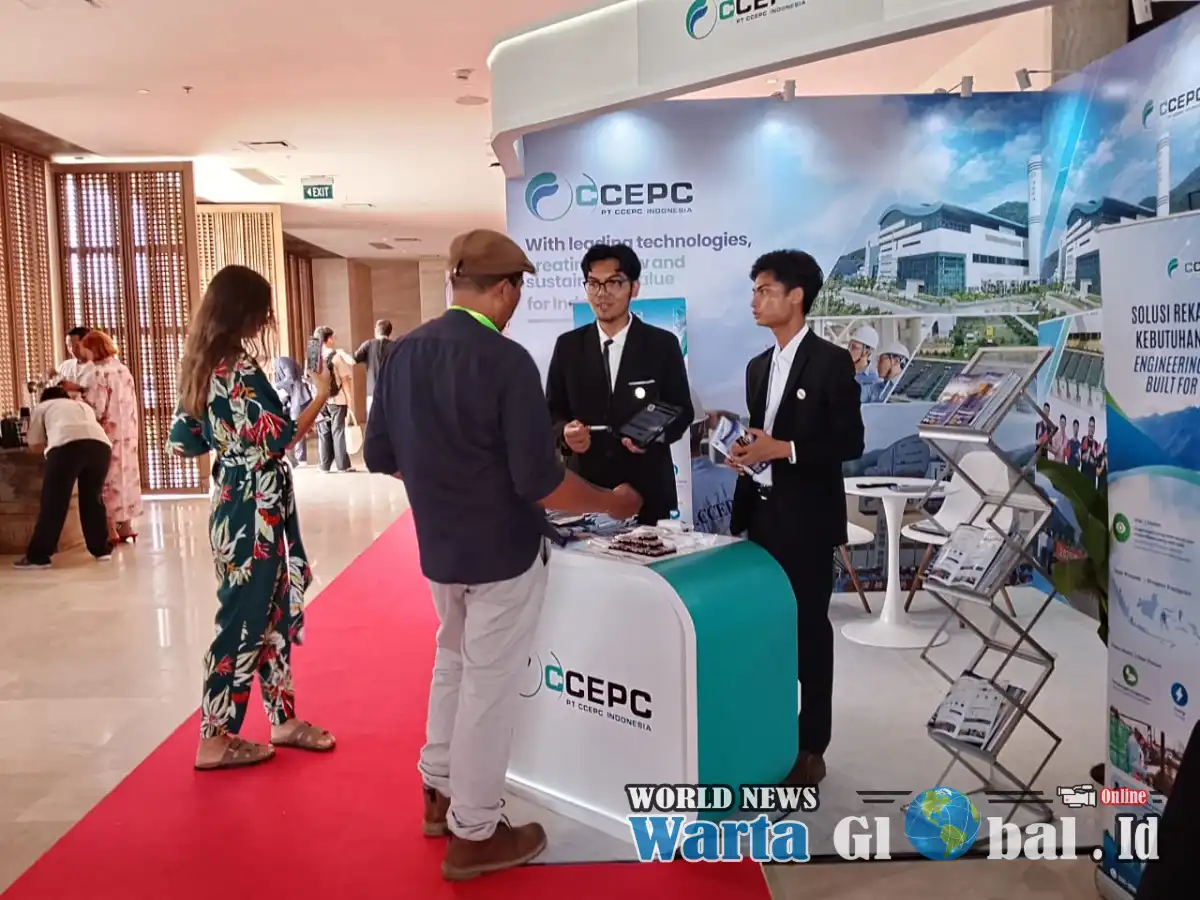
Bali Indonesia -WorldWartaGlobal.IdThrough the Indonesia-China Bridge Forum 2026 in Bali, CCEPC Indonesia introduced SWRO, Waste-to-Energy, and Solar PV technologies as strategic solutions to support the development of industrial, commercial, and residential districts.
Modern district development can no longer rely solely on architectural grandeur and property investment value. The availability of clean water, energy reliability, and waste management have become strategic factors that determine a district's competitiveness, operational efficiency, and sustainability.
This perspective was presented by PT CCEPC Environment Protection and Energy Comprehensive Utilization Indonesia (CCEPC Indonesia) during its participation in the Indonesia-China Bridge Forum 2026, held at the Renaissance Bali Uluwatu Resort & Spa, Bali, on Thursday (29/10/2026).
Carrying the message "Make Buildings Liveable," CCEPC Indonesia introduced its environmental and energy engineering capabilities and technologies to support district infrastructure needs in Indonesia. The forum served as a meeting space for property developers, investors, and construction industry players to explore opportunities for cross-sector cooperation and project development.
For CCEPC Indonesia, a modern building must be supported by an infrastructure system that enables community and business activities to run reliably. Clean water, energy, and resource management are not merely additional facilities, but essential parts of development planning from the earliest stage.
"What makes a building truly liveable? Not only its design or physical structure, but also the infrastructure that supports life and activities inside it," said Aie Natasha, ESG & Business Sustainability Senior Specialist of CCEPC Indonesia, during a forum panel session.
According to her, modern buildings still require access to clean water, reliable energy, and responsible resource management.
*Three Technologies, One Direction for Infrastructure Development*
At the forum, CCEPC Indonesia highlighted three key technologies relevant to district development needs: Seawater Reverse Osmosis (SWRO), Waste-to-Energy (WtE), and Solar Photovoltaics (PV).
The three offer different approaches to addressing challenges in water availability, energy demand, and waste management. Their application can be tailored to location characteristics, scale of demand, technical-economic feasibility, and applicable regulations.
*First, SWRO to expand alternative clean water supply.*
SWRO technology treats seawater into fresh water through a pressurized membrane process. This technology has the potential to become an alternative for coastal areas, industrial estates, and property developments facing limited raw water sources.
However, its implementation requires careful calculation, including energy needs, treated water quality, operational costs, and management of high-salinity brine. With proper planning, SWRO can become part of a water source diversification strategy for districts that need a more measurable supply.
*Second, Waste-to-Energy to promote resource recovery from waste.*
Waste management is a significant challenge as urban, industrial, and tourism areas continue to grow. WtE technology opens opportunities for energy recovery through waste treatment processes tailored to material characteristics and project needs.
In addition to supporting energy diversification, this technology has the potential to become part of a more integrated waste management system. Nevertheless, its success depends on the certainty of waste supply and characteristics, emission control, residue management, as well as financing and operational feasibility.
*Third, Solar PV to expand the use of renewable energy.*
Solar Photovoltaics technology converts solar energy into electricity and can be applied to industrial estates, commercial buildings, and other supporting facilities.
The system can be integrated with the power grid and, according to project needs, equipped with energy storage. For district managers, the use of Solar PV opens opportunities for electricity source diversification while supporting efforts to improve energy efficiency.
CCEPC Indonesia emphasized that the three technologies are not a package that must be applied simultaneously. Each project requires a solution tailored to field conditions and development objectives.
"Each district has different resource needs and operational characteristics. Technology selection must consider location, resource availability, project feasibility, and applicable regulations," explained Charles Firmansyah, Engineering Consultant of CCEPC Indonesia.
*Integrated EPC Approach, Opening Business Opportunities*
As a company engaged in Engineering, Procurement, and Construction (EPC) services, CCEPC Indonesia offers an approach covering consulting, engineering planning, procurement, and infrastructure construction according to project needs.
This integrated approach is relevant for district development that requires coordination between technical planning, technology selection, equipment procurement, facility construction, and operational readiness.
CCEPC Indonesia has been present in Indonesia since 2020, combining an understanding of local development needs with the support of engineering capabilities and technology from China.
In addition to participating in the panel session, the company also presented an exhibition booth to introduce its services and technological capabilities to developers, investors, and construction industry players.
This participation is an opportunity to expand business networks and explore partnerships in providing water, energy, and environmental infrastructure for residential, commercial, industrial, and integrated district developments.
From a business perspective, the growing need for basic infrastructure opens space for collaboration between project owners, developers, technology providers, investors, and construction partners. However, investment decisions still require in-depth studies on market needs, life-cycle costs, environmental risks, and long-term economic benefits.
*Sustainable Infrastructure Must Be Measurable*
CCEPC Indonesia stated that the support of its parent company, a Chinese state-owned enterprise listed in the Fortune Global 500, is part of the company's capability background.
According to the company, the total capacity of power plant projects built in Indonesia has exceeded 12 GW as of July 2026.
This figure is a corporate claim illustrating the company's project track record. To assess its contribution comprehensively, information on the project list, operational status, type of power plant, and capacity that is already operating and still under construction remains an important element of public transparency.
Ultimately, the success of development is not only measured by the number of buildings erected, the value of incoming investment, or the size of the developed area. A more substantial measure lies in the infrastructure's ability to provide services that are reliable, efficient, environmentally safe, and economically sustainable.
Through the message "Make Buildings Liveable," CCEPC Indonesia positions water, energy, and environmental infrastructure as a strategic part of district development. The next challenge is to translate these technological capabilities into real projects that are commercially viable, comply with environmental regulations, and provide measurable benefits to the community and businesses.
Bali became a meeting space for ideas and collaboration opportunities. Implementation on the ground will be the true measure of the value of an innovation.
About CCEPC Indonesia
PT CCEPC Environment Protection and Energy Comprehensive Utilization Indonesia is an integrated engineering solutions company in the energy and environmental sector headquartered in Jakarta since 2020. According to the company, its business focus includes clean energy, ecological governance, digitalization, and operations and maintenance. The company provides consulting, engineering, procurement, and construction services to support the needs of energy and environmental infrastructure projects in Indonesia.
Views Post


