

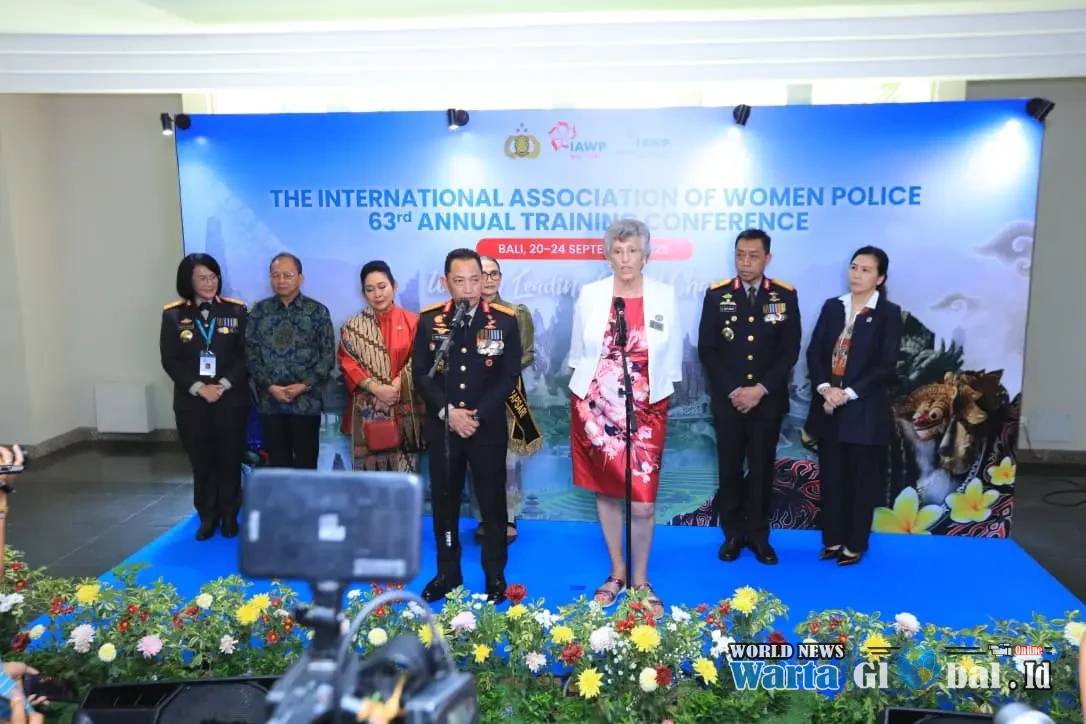
BADUNG — Word Warta Global.Id. Bali has become a meeting point for hundreds of female police officers from various countries at the 63rd International Association of Women Police (IAWP) Annual Training Conference 2026, held at The Westin Resort Nusa Dua, Bali, on Sunday (September 20, 2026).
The conference, taking place from September 20–24, 2026, carries the theme “Women Leading Global Change” and brings together police officers, police leaders, law enforcement professionals, academics, researchers, and practitioners from various countries.
However, behind the international forum lies a more substantive question for the Indonesian National Police (Polri): to what extent has gender equality actually been implemented within the organizational structure, distribution of authority, and opportunities to hold strategic positions within the Indonesian police force?
The question is relevant because gender equality cannot be measured solely by the number of women wearing police uniforms or participating in an operation. More concrete indicators include access to education, promotion, leadership opportunities, authority, and participation in decision-making processes.
Chief of Police Encourages Female Officers to Enter Strategic Positions
Chief of the Indonesian National Police, General Listyo Sigit Prabowo, emphasized the importance of strengthening the capacity and professionalism of female police officers.
According to the Chief of Police, the IAWP forum provides an opportunity for female police officers from various countries to exchange experiences, knowledge, and policing practices while strengthening professional networks.
“Through this very positive activity, we hope to exchange information, experiences, and enthusiasm to strengthen gender equality within the police environment,” said the Chief of Police.
The statement is significant because gender equality within a police institution ultimately involves more than the participation of women in operational activities.
Equality also raises a more fundamental question: do women have proportionate opportunities to occupy positions at the center of decision-making?
The call for female police officers to prepare themselves for strategic positions indicates that strengthening women's roles should not stop at administrative functions, public services, or specific areas traditionally associated with women.
Competence and professionalism should serve as the primary basis for career development.
464 Female Police Officers from 43 Countries Gather in Bali
The Bali Regional Police stated that 464 female police representatives from 43 countries were scheduled to attend the 2026 IAWP conference.
Bali Police Chief Inspector General Daniel
Adityajaya previously stated that the international event would take place in the Nusa Dua area of Badung Regency.
Security arrangements were prepared through Operation Gapura Agung IV-2026, involving 744 personnel.
The scale of the event demonstrates that IAWP is not merely an internal police gathering. It serves as a forum for exchanging experiences on women's leadership, capacity building, investigations, community relations, and police innovation.
Therefore, the commitment to gender equality will also be reflected in how the forum is organized and conducted.
It Is Not Only About How Many Female Officers There Are, but Where They Stand
The number of women within a police institution is one indicator of participation. However, that number alone does not automatically demonstrate gender equality.
There is a distinction between representation and decision-making power.
Female police officers may participate in various operational activities, but gender equality becomes more concrete when women have equal opportunities to receive leadership development training, obtain promotion based on competence, lead units, and hold positions that determine policy direction.
For this reason, the spirit of “Women Leading Global Change” at IAWP 2026 is worth examining not only from the conference stage, but also through the internal structures of each participating police institution.
For the Indonesian National Police, the question can be stated simply: how much leadership space is actually available to female police officers?
Professionalism Must Go Hand in Hand with Career Opportunities
The Chief of Police emphasized the importance of professionalism among female officers in responding to the challenges of modern policing.
The official IAWP 2026 agenda includes themes such as Professional Development & Leadership, Engagement & Collaboration, Building Community Confidence, High Profile Incidents & Criminal Investigative Techniques, and Best Practices & Innovations in Policing.
This indicates that the development of female police officers is not merely about women's representation, but also about strengthening technical and leadership capabilities.
Female officers are expected to have the capacity to address modern crimes, including transnational crime, technological developments, investigations, and community security issues.
At this point, the principle of equality becomes important: access to capacity building should go hand in hand with opportunities to exercise that competence through positions of authority and responsibility.
Strategic Positions Are a More Concrete Measure
Hosting the IAWP in Bali provides the Indonesian National Police with an opportunity to demonstrate the development of women's roles within the institution.
However, its success should not be measured solely by the successful organization of an international conference, the number of female delegates attending, or the participation of female officers in security operations.
The more substantive indicators lie within the organization itself: how career development systems operate, how promotion processes are conducted, how educational opportunities are distributed, and to what extent female officers have access to strategic positions.
If women are given opportunities to lead based on competence, gender equality takes on a more concrete form.
Conversely, if women are positioned merely as symbols of representation without adequate access to decision-making spaces, the pursuit of equality still faces significant challenges.
Bali Is the Stage, While the Police Structure Is the Mirror
Indonesia is serving as a co-host of IAWP 2026. In addition to the conference and training sessions, the program includes a Parade of Nations, an environmental activity involving mangrove planting, and cultural events.
In this context, Bali is not merely the location of the conference. It is a stage for Indonesia to demonstrate how its police institution views the role of women.
On the security side, the Bali Regional Police deployed 744 personnel through Operation Gapura Agung IV-2026. The operation also covers another international agenda, namely the 14th Senior Officer Meeting (SOM) between the Indonesian National Police and the Australian Federal Police (AFP), held from September 20–22, 2026.
The involvement of female police officers in operational and strategic security positions forms part of the broader picture of the professional space available to women within the Indonesian police force.
However, that picture needs to be examined within a broader and measurable context.
From Bali, the Gender Equality Question Must Not End with the Forum
The 63rd IAWP Conference provides the Indonesian National Police with an opportunity to build international networks and broaden the professional horizons of female police officers.
But the real challenge begins after the conference ends.
Will the exchange of experiences lead to changes in career development systems?
Will more female police officers have opportunities to lead police units?
Will access to education and promotion increasingly be determined by competence?
And most importantly, to what extent are women involved in positions with the authority to determine policies and the direction of the organization?
These questions do not diminish the importance of the IAWP conference. Rather, they are necessary to ensure that the theme “Women Leading Global Change” does not remain merely a conference slogan.
For the Indonesian National Police, gender equality is ultimately not only about how visible women are within the institution, but also how much space they are given to lead, make decisions, and shape the future of the organization.
The 63rd IAWP has opened an international stage in Bali. The concrete implementation of gender equality within the structure and strategic positions of the Indonesian National Police is now an issue that deserves continued public scrutiny.
Afkan.
Views Post


