

Allegations of Paid Participation Raise Serious Questions About Student Representation, Campus Identity, and the Integrity of Indonesian Democracy. Who Recruited Them, Who Paid Them, and Who Is Accountable?
JAKARTA – WorldWartaGlobal.Id
Student identity has become a subject of public scrutiny following the emergence of the term “Mahasewa”—a satirical expression referring to individuals allegedly wearing university jackets and presenting themselves as students without having genuine academic affiliations with the institutions represented.
The controversy emerged after the Indonesian Student Youth Pledge Declaration held at the Hotel Indonesia Roundabout (Bundaran HI), Jakarta, on October 29, 2026.
Public attention intensified when several participants wearing university jackets appeared unable to clearly explain their academic identities and institutional affiliations during media interviews.
The controversy escalated after one participant, Bayu Setiadi, also known as Dino, reportedly admitted that he was not a student of Dian Nusantara University (Undira), despite wearing its university jacket. He also acknowledged receiving payment to attend the event.
This admission does not establish that all participants were paid or that the entire gathering lacked genuine student participation. However, it raises a fundamental question: was student identity being used to create an impression of collective support that did not accurately reflect the actual composition of the participants?
A UNIVERSITY JACKET IS NOT A COSTUME
A university jacket is more than an ordinary piece of clothing. It represents an academic institution, student identity, intellectual development, and institutional pride.
Wearing such an emblem carries symbolic responsibility.
When someone with no academic affiliation to a particular university wears its jacket in a public event, potentially creating the impression that they represent that institution, the issue goes beyond personal appearance. It becomes a matter of public trust and institutional integrity.
Receiving payment for legitimate work or event assistance is not inherently wrong. The ethical problem arises when payment is accompanied by misrepresentation or when individuals are presented as representatives of student communities they do not actually belong to.
Student identity must never become a commodity that can be rented to manufacture public legitimacy.
WHO RECRUITED THE PARTICIPANTS, AND WHO IS ACCOUNTABLE?
The declaration was organized by the Jakarta Metropolitan Police (Polda Metro Jaya), involving students and public figures. The event was also attended by Raffi Ahmad, the Presidential Special Envoy for Youth Development and Arts Workers.
This raises several questions that deserve transparent answers:
- Who recruited and coordinated the participants?
- Who provided the university jackets worn during the event?
- Were participants' academic identities verified?
- Were payments provided, and if so, by whom and for what purpose?
- Were the participants authorized to represent their respective student organizations or universities?
These questions are not accusations against all participants or the event organizers. They are legitimate questions arising from a publicly reported admission that warrants institutional clarification.
STUDENT MOVEMENTS MUST NOT BECOME POLITICAL DECORATION
Indonesian students have historically played an important role in defending democracy, challenging injustice, and holding public institutions accountable.
The strength of student movements has never depended solely on the number of people gathered in a public square.
Their legitimacy comes from independent thinking, intellectual courage, critical research, and genuine participation.
If university identities can be borrowed or distributed to create an artificial impression of student support, the distinction between authentic participation and manufactured representation becomes increasingly blurred.
The consequences extend beyond those directly involved.
Genuine student activists who work through research, public discussions, and peaceful demonstrations may also face growing public suspicion.
Students, who should be agents of social change, risk being reduced to instruments of public image-making.
UNIVERSITIES HAVE THE RIGHT TO PROTECT THEIR INSTITUTIONAL IDENTITY
Universities have a legitimate interest in protecting their names, symbols, and academic reputations.
The clarification issued by Undira's student organization illustrates why institutional verification matters.
The participation of an individual student does not automatically constitute an official position of a university, its student executive board, or its academic community.
There must be a clear distinction between individual participation, organizational representation, and an official institutional mandate.
WARTAGLOBAL CALLS FOR TRANSPARENCY AND ACCOUNTABILITY
This controversy should become an opportunity to evaluate how public events recruit participants and use university identities.
The organizers should publicly explain the recruitment process, the origin of the university jackets, the existence and source of participant payments, and the extent to which participants were authorized to represent student organizations.
Polda Metro Jaya should also clarify its participant verification procedures and the use of university symbols during the declaration.
The objective is not to condemn every participant. It is to ensure that public perception and democratic legitimacy are not built upon misleading representations.
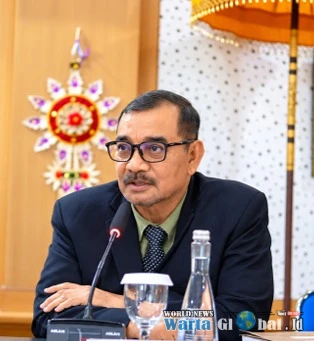
As emphasized by Dr. I Ketut Suar Adnyana, M.Hum., an academic at Dwijendra University, in his discussion of the Mahasewa phenomenon, student identity must not be reduced to a theatrical accessory.
Democracy does not need rented students to manufacture an appearance of support.
It needs students who think independently, speak honestly, and have the courage to defend their convictions.
When academic identity loses its meaning and university symbols become instruments of public performance, what is at stake is not merely institutional reputation. It is public trust in the student movement and the integrity of Indonesian democracy itself.
Views Post


