

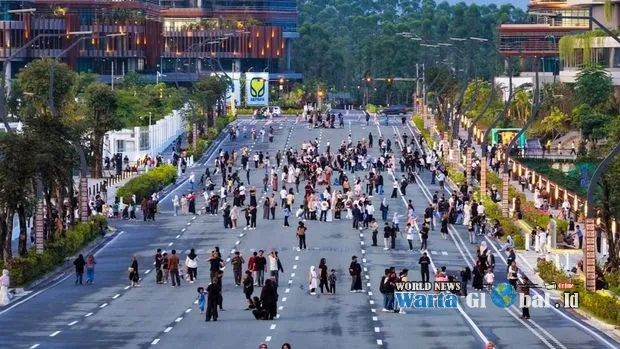
Penajam Paser Utara, WartaGlobal.Id – A significant surge in visitors to Indonesia’s new capital city project, Nusantara (IKN), during the extended March 2026 holiday period has drawn widespread attention. Official data recorded 352,102 visitors crowding the Core Government Area (KIPP), with more than 80,000 vehicles entering the site between March 18 and 29.
This figure underscores the high level of public curiosity toward the strategic national project, which continues to spark both support and criticism.
Several locations have emerged as major attractions, including the State Palace of IKN, the National Mosque, and tourism spots such as the Sepaku Semoi Dam and the Glass Bridge in the glamping area. The Ceremony Plaza and Bhinneka Plaza have also transformed into vibrant public spaces, hosting social activities, culinary experiences, and entertainment.
However, behind the enthusiasm, several concerns have surfaced. The high volume of visitors has put pressure on infrastructure readiness and public services. Field officers have faced various challenges, ranging from lost visitors to misplaced belongings, indicating that area management is still adapting to the demands of mass tourism.
Amid the bustling atmosphere, international perspectives have also drawn attention. Michael De Jong, a tourist from the Netherlands, expressed admiration for the IKN development concept, which blends modernity with nature. He described the city as unique, being built in the middle of a forest with a relatively environmentally friendly approach.
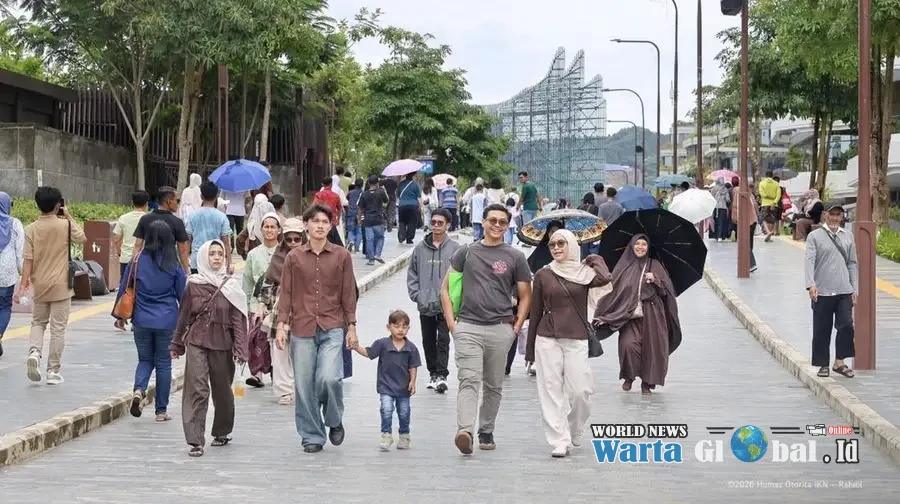
Yet his appreciation also carried a critical note. He emphasized the importance of preserving Kalimantan’s forests to ensure that development does not turn into an ecological threat. His statement reflects growing global scrutiny of ambitious projects like IKN, particularly regarding environmental sustainability.
Similar views were shared by other visitors, who see IKN as a new destination distinct from other cities in Indonesia. Meanwhile, local residents such as Sopiansah believe the development has had positive impacts, particularly in terms of accessibility and regional economic growth.
On the other hand, the government continues to accelerate infrastructure development, including educational facilities such as the establishment of Gunadarma University and Taruna Nusantara School as part of the city’s ecosystem.
Special Staff to the Head of the IKN Authority, Troy Pantouw, stated that the high number of visitors reflects strong public interest in witnessing the progress firsthand. He also appreciated the role of the media in delivering accurate information to the public.
This phenomenon highlights the dual nature of IKN: on one hand, it represents Indonesia’s vision for a modern and inclusive future; on the other, it remains a large-scale project that must be critically assessed in terms of sustainability, transparency, and social impact.
From a journalistic ethics perspective, coverage of IKN should maintain a balance between promoting development and providing data-driven criticism. Information presented must be verified, unbiased, and inclusive of diverse perspectives, including those of local communities and environmental advocates.
“If this development can remain balanced with nature, it could become a global example. But if not, it may create new problems,” said Michael De Jong. Red/*
Views Post


