

Journalistic Report | WartaGlobal.Id
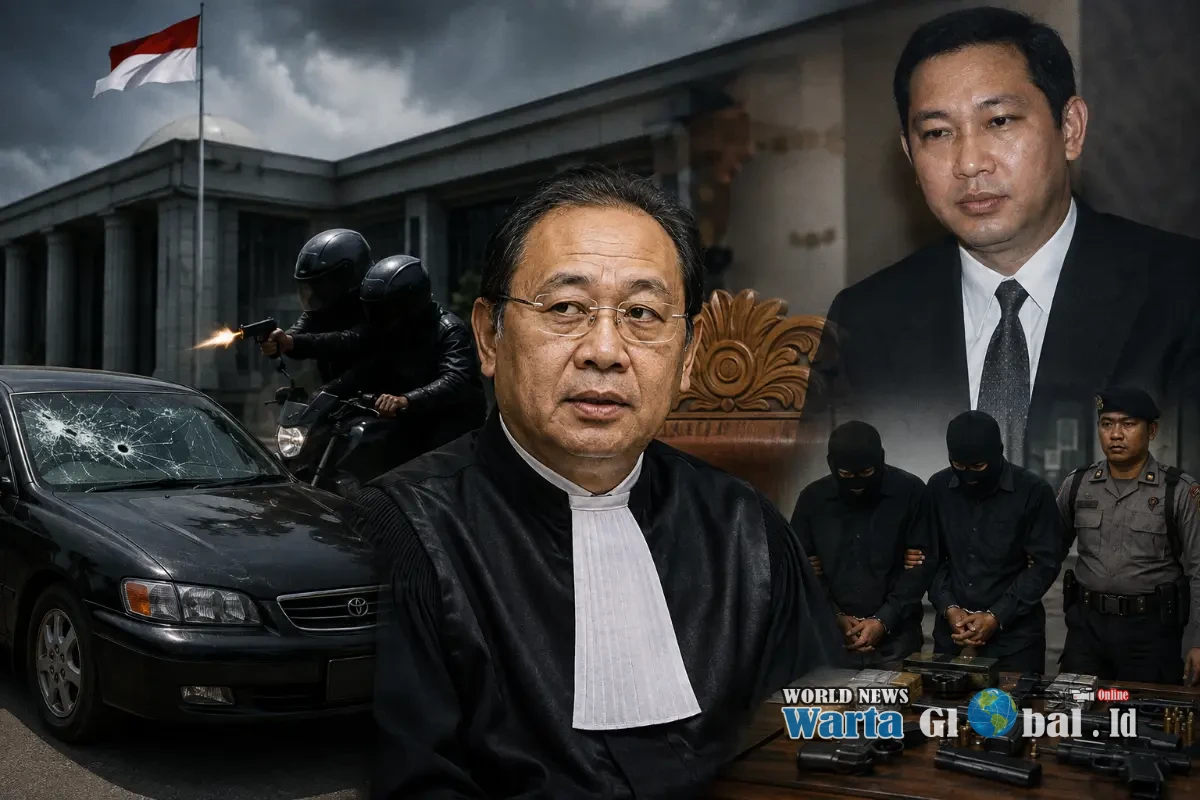
JAKARTA — Twenty-five years have passed since Supreme Court Justice Syafiuddin Kartasasmita was shot dead on his way to work. The killing on July 26, 2001, remains one of the darkest episodes in Indonesia’s judicial history because it was directly connected to a controversial criminal case involving Hutomo Mandala Putra, better known as Tommy Soeharto, the youngest son of former President Soeharto.
Syafiuddin was widely regarded as a judge who stood firmly behind the rule of law. His name became closely associated with the case after a Supreme Court panel led by him overturned Tommy Soeharto’s acquittal in a corruption-related Bulog land-swap case.
The Verdict That Changed Everything
On September 22, 2000, the Supreme Court overturned the South Jakarta District Court’s acquittal of Tommy Soeharto and businessman Ricardo Gelael.
The Supreme Court sentenced Tommy to 18 months in prison in connection with the Bulog land-swap case involving PT Goro Batara Sakti. The case was associated with state losses estimated at approximately Rp95.6 billion, while the judgment also imposed financial obligations amounting to around Rp30.6 billion.
The ruling put Tommy on a collision course with the criminal justice system.
He subsequently resisted imprisonment and became a fugitive.
The case would later take an even darker turn.
Alleged US$20,000 Bribe
One of the most sensitive aspects of the case involved an alleged attempt to influence Justice Syafiuddin.
During the trial, Syafiuddin’s widow testified about an alleged offer of US$20,000 intended to influence the judge in connection with Tommy’s case.
However, journalistically, the allegation must be presented as testimony given during the proceedings, rather than as an independently established fact. Tommy Soeharto denied the allegation.
That distinction is essential when reporting a case involving such serious accusations.
July 26, 2001: The Shooting
On the morning of July 26, 2001, Syafiuddin left his home for work.
While traveling through Jakarta, his car was attacked by gunmen riding motorcycles.
Shots were fired at the vehicle.
Syafiuddin was fatally wounded and died while being taken to hospital.
The assassination immediately triggered a massive police investigation.
A Supreme Court justice had been murdered in broad daylight.
And the killing occurred less than a year after the court had sentenced the son of one of Indonesia’s most powerful former presidents.
The Arrest of the Gunmen
On August 7, 2001, police arrested two men identified as Raden Maulawarman alias Molla and Noval Hadad.
Investigators linked the two men to the shooting.
During the investigation, they reportedly confessed that they had carried out the killing on orders connected to Tommy Soeharto, allegedly receiving approximately Rp100 million.
The case subsequently moved from the streets into the courtroom.
Tommy Soeharto Convicted
Tommy Soeharto was eventually arrested after months as one of Indonesia’s most wanted fugitives.
The Jakarta Central District Court later found him guilty of crimes connected to the assassination, including soliciting the murder of Justice Syafiuddin.
On July 26, 2002, exactly one year after the killing, Tommy was sentenced to 15 years in prison.
The court found that Tommy had persuaded the two men to carry out the murder and had provided money for the operation.
This is an important distinction: Tommy’s involvement was not merely a media allegation. He was convicted by a court of law.
The Two Gunmen Receive Life Sentences
The two gunmen, Maulawarman and Noval Hadad, received life imprisonment from the Central Jakarta District Court.
The punishment became another controversial element of the case.
The two men who physically carried out the shooting received life sentences, while Tommy—whom the court found responsible for soliciting the murder—initially received a 15-year sentence.
That disparity continued to fuel public debate about justice, accountability and equality before the law.
Tommy's Sentence Was Later Reduced
Tommy's legal battle did not end with the 15-year sentence.
Through subsequent legal proceedings, including a judicial review, his sentence was reduced to 10 years.
Various sentence reductions and remissions subsequently shortened the period he actually spent behind bars.
He was eventually released on parole in 2006.
The release generated criticism from civil-society groups, including Indonesia Corruption Watch, which questioned the extent of the remission granted to Tommy.
Government officials at the time maintained that the release was carried out under applicable legal mechanisms governing remission and parole.
A Dark Chapter in Indonesian Judicial History
The murder of Syafiuddin Kartasasmita remains significant because it represents more than the killing of one individual.
It raises fundamental questions about:
- the independence of judges;
- protection for judicial officers;
- equality before the law;
- the influence of wealth and political power;
- and public confidence in Indonesia’s justice system.
A Supreme Court justice issued a controversial ruling against the son of a former president.
Months later, that justice was assassinated.
The investigation led to the arrest of the shooters.
The shooters were sentenced to life imprisonment.
And Tommy Soeharto was ultimately convicted by the court for soliciting the murder.
Yet the subsequent reduction of his sentence and his eventual release generated continuing public controversy.
The Lesson That Remains
The tragedy of Syafiuddin Kartasasmita should not merely be remembered as a sensational murder case.
It should be remembered as a test of the principle that the law must stand above power.
A judge cannot be truly independent if delivering an unpopular verdict places his life at risk.
And a justice system cannot command public confidence if citizens believe that wealth, political connections or family background can produce different standards of accountability.
Twenty-five years later, the central question remains relevant:
Can the rule of law truly be independent when the law confronts power?
The legacy of Syafiuddin Kartasasmita demands that Indonesia continue to ask—and answer—that question.
Journalistic Sources
- Supreme Court of the Republic of Indonesia — court documentation concerning the Tommy Soeharto case and the murder of Syafiuddin Kartasasmita.
- ABC News — contemporary reporting on the arrest of suspects in the assassination investigation.
- The Guardian / Associated Press — contemporary reporting on Tommy Soeharto’s conviction.
- Hukumonline — reporting on the trials and sentences of the two gunmen.
- detikcom — reporting on Tommy Soeharto’s subsequent imprisonment, remission and release.
- Indonesia Corruption Watch (ICW) — criticism concerning remission and parole.
Editorial Note: This report distinguishes between facts established by court judgments, testimony presented during proceedings, allegations, and subsequent commentary. Serious allegations are not presented as independently proven facts unless supported by judicial findings or reliable documentary evidence.
Views Post


